
What Is a “Ramp” Under the NCC/BCA? Clarifying an Ongoing Accessibility Grey Area
In accessibility compliance, few topics generate as much practical uncertainty as the definition of a “ramp”, particularly when it comes to handrail requirements under the NCC/BCA and AS 1428.1.
At VBC, we regularly encounter varying interpretations across projects, practitioners and approval authorities. This blog outlines our position, explains where the ambiguity comes from, and clarifies how to reasonably navigate this issue.
The Core Issue: The NCC/BCA Does Not Define “Ramp”
One of the challenges begins with a simple fact:
The NCC/BCA does not provide a definition of a “ramp.”
Within Part D3 – Construction of Exits, Clause D3D22(1) requires handrails on ramps, subject to width and layout. However, without a clear definition, the question becomes:
What types of ramps does this actually apply to?
This lack of clarity creates uncertainty, particularly when considering smaller elements such as:
- Step ramps
- Threshold ramps
- Kerb ramps
Under some interpretations, all inclined surfaces could be considered “ramps,” potentially triggering handrail requirements that conflict with common accessibility practice.
Where the NCC/BCA Points Us Next: AS 1428.1
Clause D3D22(4) of the NCC/BCA states that handrails required to assist people with a disability must comply with Clause D4D4.
Clause D4D4, in turn, requires that ramps (excluding fire-isolated ramps) comply with Clause of AS 1428.1-2021 (previously clause 10 of AS1428.1-2009).
This is the key link that allows us to look to AS 1428.1 for clarity.
AS 1428.1: Clear Definitions for Different Types of Ramps
Unlike the NCC/BCA, AS 1428.1 provides explicit definitions for different ramp types, including:
- Ramp:
Inclined surface between landings with a gradient steeper than 1:20 and not steeper than 1:14. - Step ramp:
Maximum rise of 190mm, maximum length of 1900mm, maximum gradient of 1:10. - Threshold ramp:
Maximum rise of 35mm, maximum length of 280mm, maximum gradient of 1:8. - Kerb ramp:
Maximum rise of 190mm, maximum length of 1520mm, maximum gradient of 1:8, located within or attached to a kerb.
This distinction is critical because each ramp type has different compliance requirements.
When Are Handrails Actually Required?
AS 1428.1 is very clear on this point:
- Ramps exceeding 1900mm in length with a gradient steeper than 1:20 and not steeper than 1:14 – Handrails required (Clause 7.3)
- Step ramps, threshold ramps and kerb ramps – Handrails are not required
By contrast, relying solely on Clause D3D22(1) of the NCC/BCA without reference to AS 1428.1 may lead to the incorrect assumption that all ramps require handrails.
VBC’s Position
VBC is of the opinion that:
- The NCC/BCA references to ramps within Part D3 are ambiguous due to the absence of a formal definition.
- However, it is both reasonable and appropriate to rely on AS 1428.1 for:
- Defining different types of ramps
- Understanding whether handrails are required
- Ensuring consistency with the intent of accessible design
Where handrails are intended to assist people with disability (as referenced in Clause D3D22(4)), the NCC/BCA clearly points us toward AS 1428.1 as the governing Standard.
A Practical Example
Consider a step ramp:
- Under a broad reading of NCC/BCA Clause D3D22(1), one might assume handrails are required.
- Under AS 1428.1, step ramps are expressly defined and do not require handrails.
In our view, applying AS 1428.1 in this context aligns more closely with both:
- The functional intent of the NCC/BCA, and
- Accepted accessibility practice.
NCC/BCA 2025 Draft Supports This Interpretation
It has been noted that the draft NCC/BCA 2025 Clause D3D22 now explicitly distinguishes between different ramp types and their handrail requirements:
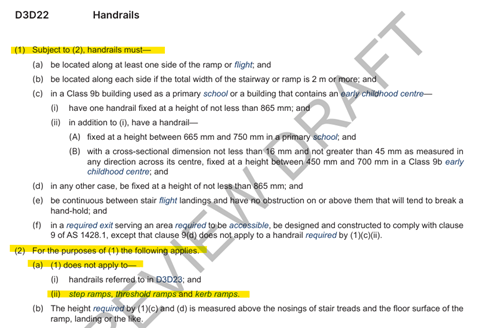
This development strongly supports VBC’s position that handrails are not required for step ramps, threshold ramps or kerb ramps.
Conclusion
Until the NCC fully resolves this issue, AS 1428.1 remains the most reliable reference point for interpreting what constitutes a ramp, and when handrails are genuinely required.
If you’re navigating this issue across design, approval or construction, alignment with both your PCA and the relevant Australian Standards is essential. Reach out to VBC for advice and assistance when navigating ambiguities between the NCC/BCA and Australian Standards.
Recent blogs
Ramps and Handrails – NCC/BCA Ambiguity Meets AS 1428.1 Clarity
What Is a “Ramp” Under the NCC/BCA? Clarifying an Ongoing Accessibility Grey Area In accessibility [...]
Read moreApr
AS 1735.12 Unpacked: 1999 vs. 2020 and the Fresh Details for Accessible Lift Design
AS1735.12- 1999 vs 2020 While not a referenced document under the NCC 2022, or proposed [...]
Read moreMar
From 2009 to 2022: The Key Updates in AS2890.6 Off-Street Parking for People with Disabilities
While not a referenced document under the NCC 2022, or proposed to be referenced under [...]
Read moreMar
Creating Inclusive Sport Venues and Events with Vallabh Bailey Consulting
At Vallabh Bailey Consulting (VBC), we are a team of qualified Access Consultants who specialise [...]
Read moreFeb
Enhancing Communication: The Role of Hearing Augmentation
In the realm of accessibility and inclusivity within professional environments, ensuring effective communication is paramount. [...]
Read moreSep
Accessible, But Locked: How Councils Utilise MLAK Systems
Public toilets are essential infrastructure, especially for people with disabilities. Yet in many areas, access [...]
Read moreJul